


Did you know your brain is being ‘hijacked’ by a world designed to keep you constantly stimulated — making it harder than ever to focus and enjoy the simple things?
Many of us feel overwhelmed, mentally fatigued, and struggle to concentrate, constantly seeking the next “cheap dopamine” hit from our phones and digital devices.
This overstimulation has desensitized us, leaving us feeling unmotivated and finding everything boring.
Imagine a life where you’re more focused and motivated, and where you find genuine enjoyment in everyday tasks and experiences.
That is something we all want.
And you can easily achieve that through something I call Dopamine Fasting.
It’s not a monk-mode one-time detox, but a sustainable lifestyle adjustment — to help you rebalance your brain, boost your focus, and rediscover everyday joy in a hyper-stimulated world.
The High Cost of Cheap Dopamine
Dopamine 101: The Neuroscience of Motivation
Dopamine is one of the most important chemicals in our body.
It isn’t just about pleasure; it’s the critical neurotransmitter responsible for motivation, reward, and craving.
It is what drives us to take actions, seek out, and achieve goals.
It is the brain’s fuel for motivation — Without it, you will not have any desire to do anything, even the simplest tasks.
To truly understand this, consider a fascinating study with rats:
Scientists divided rats into two groups:
Group 1 (Normal Dopamine): These rats were placed in a cage where they had to press a lever to receive food pellets. They repeatedly pressed the lever to get food. Even when they were moved a short distance away from the lever, they would return to push it for food.
Group 2 (No Dopamine): Through injection, the scientists eliminated these rats’ dopamine neurons so that they couldn’t produce dopamine anymore. Interestingly, these rats still ate and enjoyed the food when it was provided. However, when moved even a short distance (around 15 centimeters) from the lever, they would not move at all to press it for food. They simply lacked the motivation to initiate the action, even though they experienced pleasure from eating.
This groundbreaking study reveals that:
You don’t need dopamine to experience pleasure.
But you do need dopamine to be motivated to seek pleasure and take action towards goals.
As essential as it is, the brain has a limited capacity for how much dopamine it can produce per day.
Constant overstimulation can deplete and desensitize the system, leading to a “dopamine deficit state.”
In this state, you will not feel motivated to pursue any tasks, even if you know the outcome will be enjoyable or beneficial.
Unfortunately, that is the problem most of us face, living in our world today.
The Risks of Living in Today’s World
Thanks to explosive technological development, we have changed the world in the last century more than we did in hundreds of thousands of years before that combined.
But our brain is still designed for a lifestyle in the old world, which was completely different from our own today.
Throughout our evolution, dopamine was the chemical that motivated us to do things that ensured our survival (hunting, shelter-building, and connecting with others)
In our modern world, we have found ways to effectively hack this ancient reward system, stripping it of its original, life-sustaining purpose.
By simply living, we take on risk.
But not the good type of risk.
The risk of binge tech (social media, streaming, gaming, and news).
The risk of simulated sexual stimulation (pornography and dating apps).
The risk of consumables (alcohol, drugs, junk food).
The risk of thrill-seeking (gambling, shopping sprees, or extreme spots).
— Dan Koe
This constant overstimulation exploits our brain’s reward system, depletes our dopamine stores, creates unnatural spikes, and raises the bar for what we consider stimulating — making it increasingly harder to resist these highly dopaminergic stimuli.
The Erosion of Focus and Enjoyment
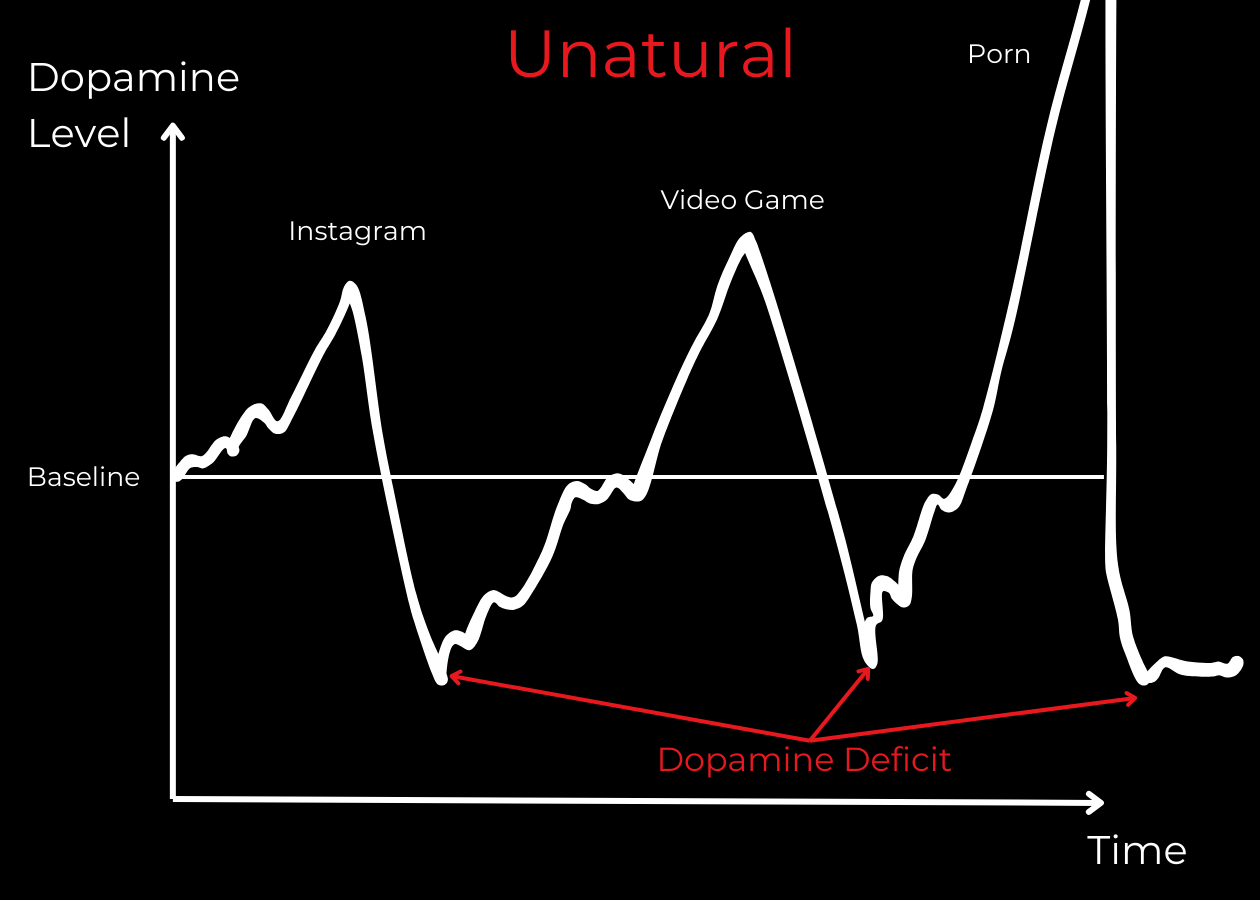
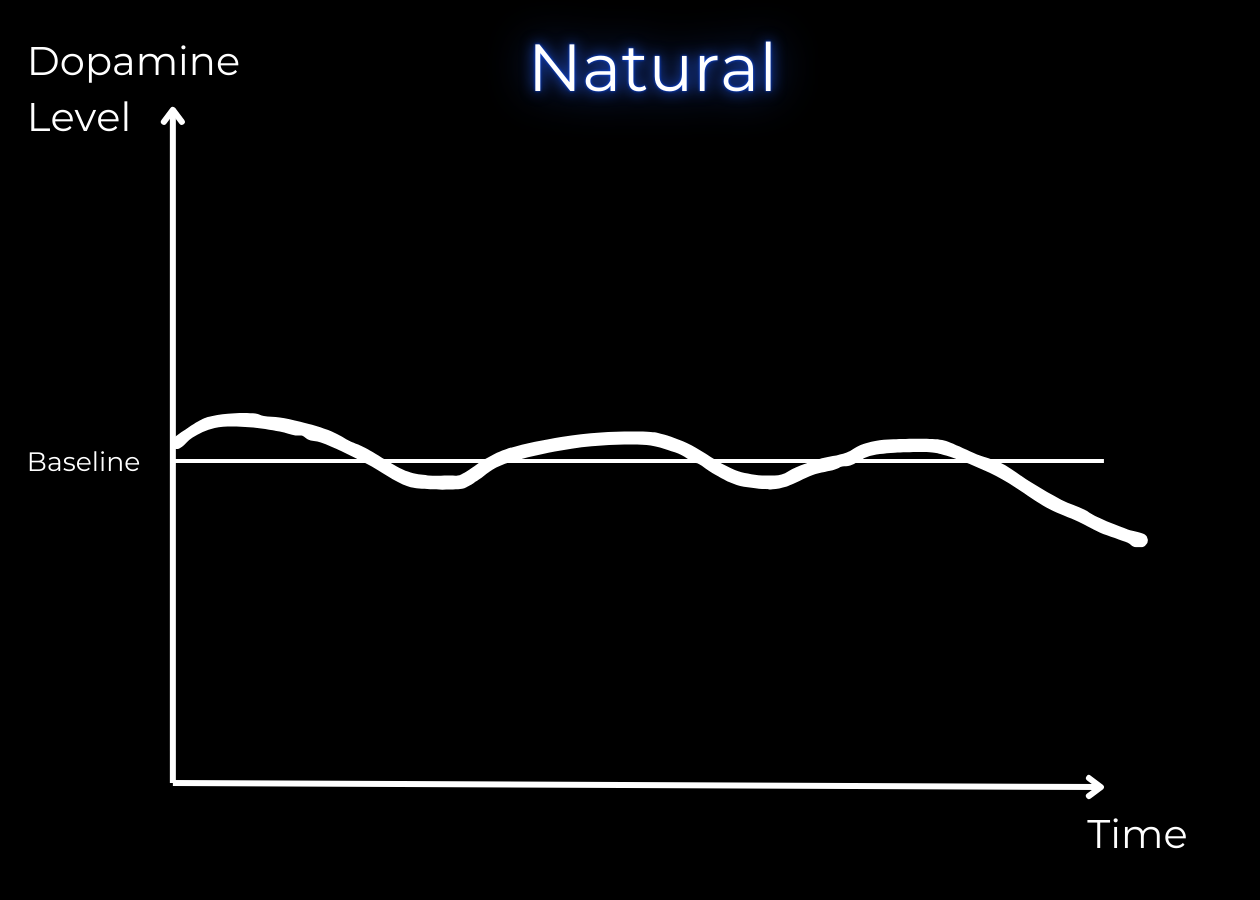
As I mentioned above, our brain can only produce a limited amount of dopamine per day.
That is why our brain will always try to maintain a certain level of dopamine (so that it has the time to rest and produce more) — and that is our baseline.
The problem with constant stimulation is that it creates unnatural dopamine spikes.
And because the brain will try to restore the level to baseline, it will first crash below it before increasing back up again.
These crashes will result in a dopamine deficit state.
In this low-dopamine state, you will not feel any motivation to do anything at all.
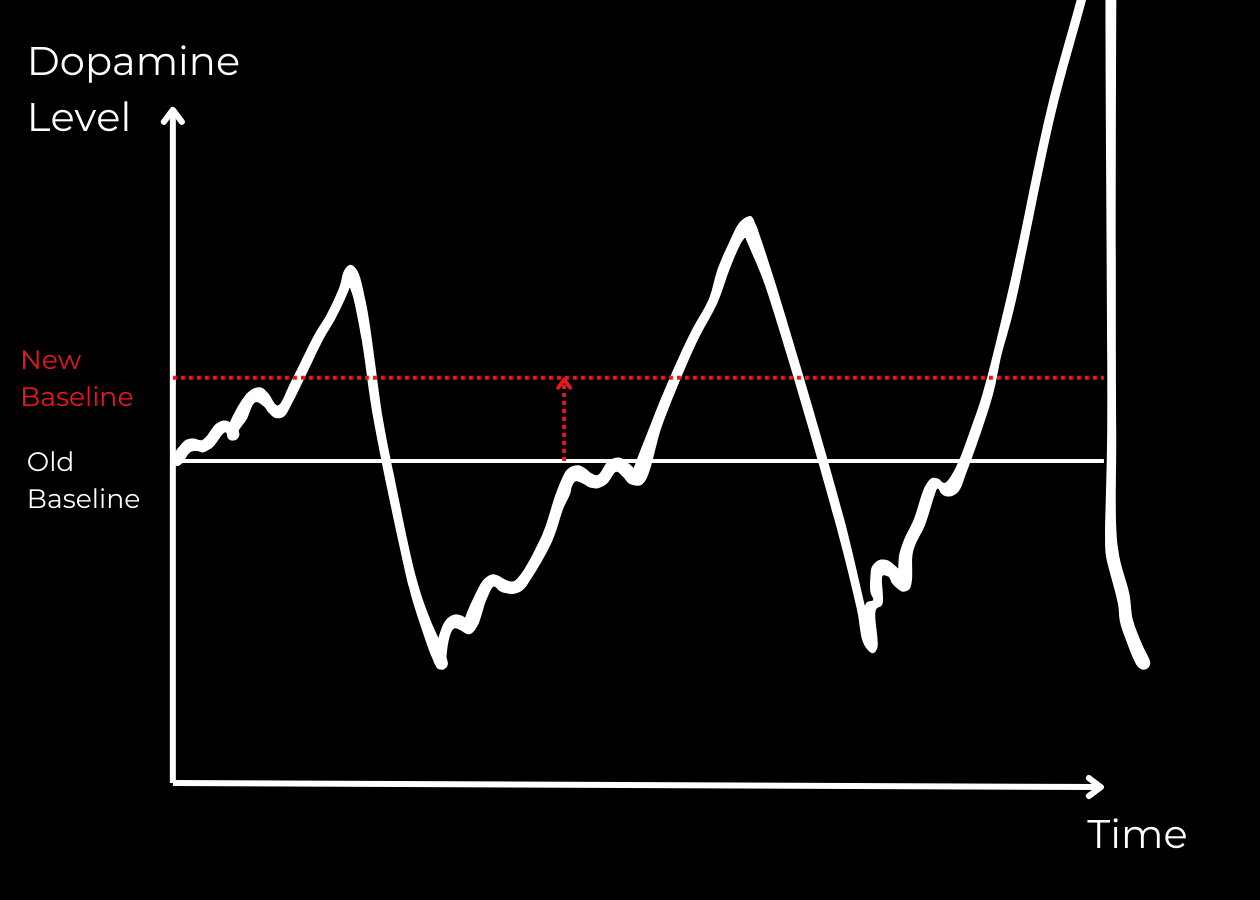
If this happens frequently, the bar for what you consider stimulating will be increased, and you will feel the need to constantly seek more intense dopamine spikes — Just like a drug addict who needs higher doses of the drug over time.
Basically, you will be desensitized, and everything that is less stimulating than your phone will be automatically labeled as boring.
This desensitization means you will lose the ability to find joy and motivation in everyday life and even in simple tasks.
Back when I was a chronic procrastinator, I would spend hours just binge-watching Netflix, reading manga, or playing video games.
And I would constantly feel the need to switch between series and find new ones to watch, because otherwise I would find it dull and boring very quickly.
Not only that, I found it so hard to do simple everyday chores like washing dishes or cooking that I literally need to listen to music — just to bring myself to do them.
When you are in this dopamine deficit state, you will also find it extremely difficult to focus and get anything done — because overstimulation destroys the potential for flow states as you find everything boring and unrewarding.
So, if you are like I was and start the day by scrolling on your phone, you will find it extremely challenging to concentrate later in the day and may even experience brain fog due to a sustained low dopamine state.
Also, I thought it was fine to relax a bit during breaks by playing games or checking my phone.
But these stimulations and fast dopamine activities only make it harder to focus afterwards and even cause decision fatigue — because I would have to make myself stop and start working again.
Which was almost impossible to do because it was so addictive, and my dopamine level was so low (So I constantly feel the need to chase after more fast dopamine).
If I failed to stop, I would try to run away from my shame by procrastinating more and wasting even more time.
Mentally Obese: Suppressed Emotions and Procrastination
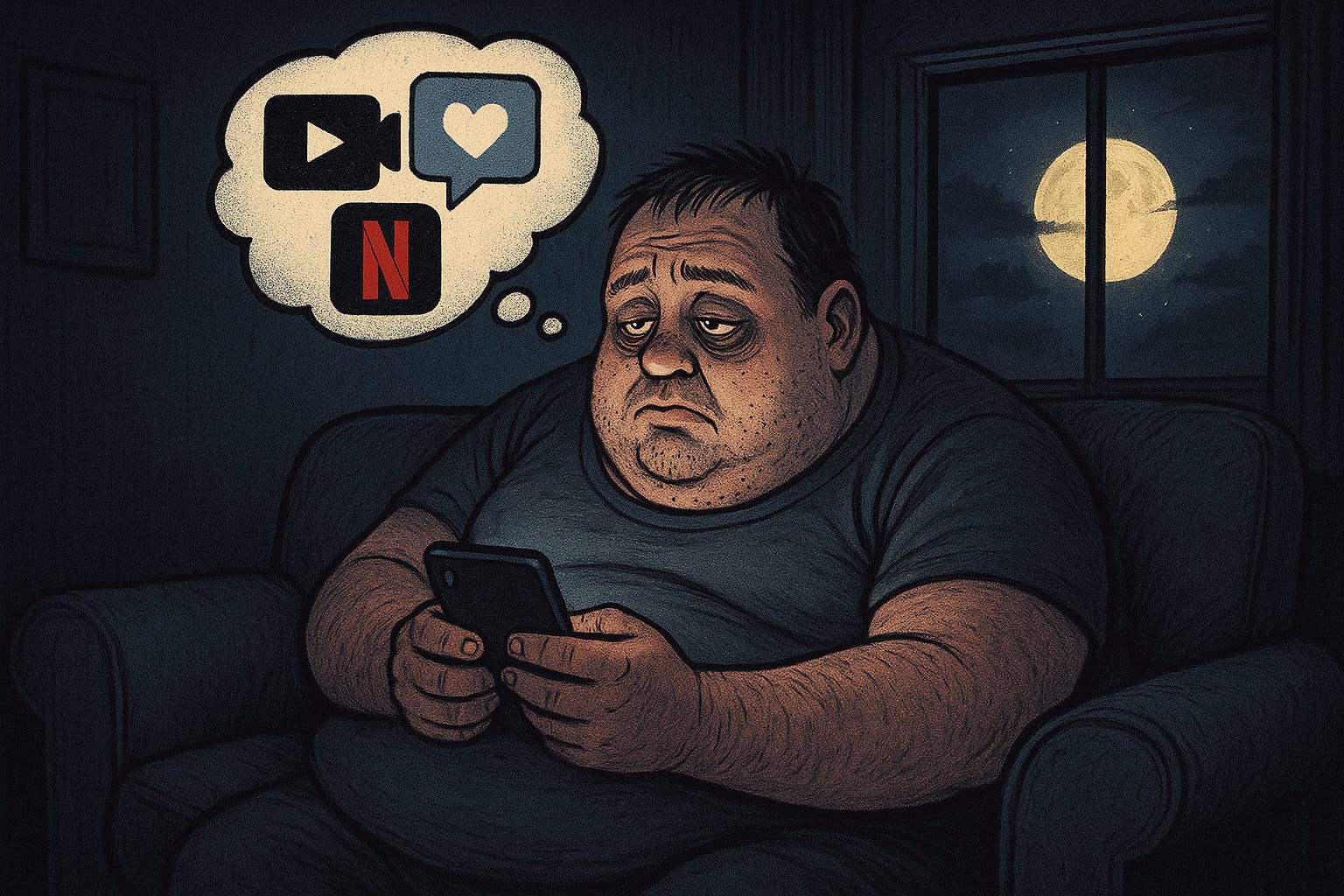
If you were to binge on information (social media as a prime example) every day since you’ve had the app installed on your phone, you’re walking around mentally obese. You don’t notice it because it’s become normal (homeostasis).
— Dan Koe
Our brain is only capable of processing a limited amount of information through conscious thought.
About only 10 bits per second, a fraction of the roughly 1 billion bits per second of information gathered by our senses.
Yet we constantly bombard it with new, fast information through our phones (news, reels, shorts), which can lead to context collapse and information overload.
This constant mental binging is, for many, a way to escape reality, which prevents them from processing thoughts and emotions.
I was one of them, too.
Whenever I felt stressed, or something bad happened that made me sad (being rejected, doing something embarrassing, scoring poorly on a test) — I would lock myself in my room, cover myself with my warm blanket, and escape to my comfortable world of Netflix, Manga, and video games.
So instead of confronting my problems and emotions, I would suppress them and try to run away through more stimulation, which leads to increased procrastination, wasting time, and a feeling of unmotivation, unable to get out of bed — or “bed rotting (as many call it nowadays).”
This constant pursuit of fast dopamine and stimulation creates a vicious cycle of a bad habit of escaping reality, and can even lead to addictive patterns.
The Vanishing Attention Span
The rapid-fire content of social media and short videos trains your brain for fleeting attention rather than sustained focus.
This contributes to difficulty with deep work and learning, making it harder to engage with complex tasks or long-form content.
Also, your brain will become conditioned to constant stimulation, leading to anxiety and restlessness when not actively engaged.
This is a sad reality I’ve observed: people always listen to music or are on their phones when they’re outside the house.
So instead of observing life, contemplating your thoughts, or talking with others, it has simply become the norm to take out your phone and scroll when you have nothing to do.
All of humanity’s problems stem from man’s inability to sit quietly in a room alone.
— Naval Ravikant
Recap: The Cycle of Overstimulation
In essence, the modern world is designed to hijack your brain, constantly feeding it cheap dopamine.
This leads to a higher baseline for stimulation, making genuine focus, motivation, and enjoyment harder to achieve.
The result is a cycle of overwhelm, mental fatigue, and a constant craving for more, yet ultimately less satisfying, stimulation.
Without addressing this, we risk becoming perpetually unmotivated, disengaged from meaningful tasks, and unable to experience true satisfaction and joy in life.
Reclaiming Your Brain’s Natural Blueprint
In order to do this, you will need to rebalance your dopamine system.
When your dopamine system is balanced, you’ll find it a lot easier to concentrate and do hard work.
Getting into flow states will become more frequent and effortless.
Before, I would feel bored after just a few minutes of trying to work on a task, which led me to distract myself and seek cheap dopamine from my phone.
Now, because the cheapest form of dopamine comes from working on the task, I can focus much longer and even find the work itself satisfying.
To focus in your life, you need to be able to enjoy and derive enjoyment from just the simple things.
— Iman Gadzi
You will also be able to experience simple joy in life and daily tasks again, which is really enlightening.
I have noticed that I pay more attention to life and other people and am able to appreciate little things in life — which I didn’t before because I was always on my phone.
By resisting instant gratification, you will build a stronger willpower to endure discomfort and delay rewards — leading to greater patience and resilience in all areas of life.
Without constant stimulation, you will give your brain time to rest and space to process suppressed problems and emotions.
This will give you mental clarity and enhance your ability to think deeply.
And by embracing boredom, you will also allow your mind to wander and tap into your creative mode, giving you novel ideas and helping you solve problems.
Many of my newsletter ideas come from my walks.
Also, by not having the phone to engage with during my breaks, I can think more about the task I was doing or something I’m learning — to understand the topic better and come up with better ways to do the task, creating even better results (like me writing this newsletter now).
By reducing reliance on digital devices and being able to enjoy life more, you will become more present and engaged in real-world interactions — leading to deeper and more fulfilling connections with others.
I have found that I’m now more interested in other people and want to go out more in the evening instead of staying indoors watching Netflix and playing video games, as I used to.
Lastly, by getting your dopamine system back in balance, you will have sustainable motivation to tackle challenging, long-term goals rather than seeking fleeting instant gratification.
To do that, you will need to fast from cheap dopamine.
Your Step-by-Step Guide to Dopamine Fasting
Just like with intermittent fasting, you will have a time window to fast from your phone and the cheap dopamine sources.
This doesn’t mean that you won’t be able to watch Netflix or play video games anymore. It just means that you delay it and schedule a limited time window for it later in the day.
The Dopamin Fasting Principle: Do all the work first thing in the day, and do the fun stuff later.
This will trick your brain into doing challenging tasks while still allowing yourself to enjoy what modern life has to offer.
Step 1: Identify your High-Dopamine triggers
Recognize the “cheap dopamine” sources in your phone. This could be any app, website, or game.
Step 2: Set a fasting period
With intermittent fasting, I have a 16/8 window of fasting/eating.
With dopamine fasting, I do a 21/3 window of fasting/enjoying phone.
You can start with a shorter fasting window and slowly increase as you get more used to it.
Your fasting time will be from when you should stop using your phone and get ready for sleep to when you are allowed to enjoy it again.
Mine is from 11 pm (1 hour before bed) until 8 pm the next day.
Between 8 pm and 11 pm, I am allowed to do whatever I want on the phone (watching Netflix, reading Manga, playing video games)
Outside this window, I can still use my phone for my work and other reasons, just without these cheap dopamine sources.
Step 3: Use app blockers
As I said, today’s world is designed against you.
But it would be stupid not to use a smartphone, given the many benefits it offers.
That’s why, instead of just relying on your willpower, you need to leverage technology to your advantage.
You will use an app blocker to block all the distracting, fast-dopamine sources that you’ve identified for the fasting time window you’ve set above.
You will also need to pay for the premium version to prevent you from uninstalling the app or stopping the blocking.
Step 4: Do hard things
In the morning, after waking up, your brain is at its peak in focus and performance.
So this is when you should prioritize the most challenging tasks that require the most thinking and effort.
This includes studying, deep working, writing, making important decisions, etc.
For an added effect and extra boost of focus, you can exercise before getting to work (which is what I do every day).
Just be careful not to overdo it because it would decrease your focus instead of boosting it.
NON-Negotiable: Avoid the Ultimate Cheap Dopamine
Porn = NO GO
This is the worst form of overstimulation and cheap dopamine just after drugs.
So avoid it at all costs, even in your “fun” window.
Block all the porn sites that you can think of!
Conclusion: A Lifestyle, Not a One-Time Detox
We’ve explored how the modern world’s onslaught of cheap dopamine hijacks your brain, leading to lost focus, suppressed emotions, and a vanishing attention span.
By implementing Dopamine Fasting – a process of intentionally limiting highly stimulating inputs, you will be able to reconnect with your brain’s natural blueprint for sustained focus, joyful, simple pleasures, and consistent motivation.
This, for me, is not a one-time detox but a sustainable lifestyle that you can and should maintain for the rest of your life.
By limiting your access to cheap dopamine, you can have a richer, more fulfilling, and more meaningful life.
Your life shouldn’t be spent on your phone
— Kien Tran
Thank you for reading, and see you in the next one.
— Kien
If you enjoyed this article and are serious about reaching life mastery, subscribe to my weekly newsletter.
Every issue gives you lessons and actionable guidance to level up in all areas of your life.